A Christmas Carol for 11+: themes, characters, vocabulary and practice questions
The short answer
A Christmas Carol is a short ghost story about Ebenezer Scrooge, a mean old moneylender who is shown his past, present and possible future and learns to become generous. For 11+ practice, it offers rich vocabulary, long sentences and plenty to infer. Below you'll find the main themes and characters, plus a short extract from the original with 6 free questions and model answers.
What is A Christmas Carol about?
A Christmas Carol is a short ghost story about Ebenezer Scrooge, a mean old moneylender who is shown his past, present and possible future and learns to become generous.
Charles Dickens's novella was first published in 1843. Ebenezer Scrooge, a cold-hearted moneylender, is visited by the ghost of his old business partner and then by three spirits on Christmas Eve.
Why is A Christmas Carol good for 11+ English practice?
Scrooge changes a great deal from beginning to end, so it suits questions about how and why a character's feelings change, and the ghosts are full of symbolism. Older books like this use longer sentences and less familiar words than most modern children's fiction, which is good preparation for the kind of passages that often appear in comprehension papers.
What are the main themes?
- Greed and generosity: Scrooge begins as the most selfish man in London and ends as one of the kindest.
- Change and second chances: The story argues that anyone can change if they are willing to.
- Poverty and responsibility: Through the Cratchit family, Dickens shows that the rich should help the poor.
- Family and Christmas spirit: Fred and the Cratchits show warmth and togetherness, which Scrooge has shut out.
Who are the main characters?
| Character | Who they are |
|---|---|
| Ebenezer Scrooge | a cold, miserly moneylender |
| Jacob Marley | Scrooge's dead business partner, who returns as a ghost |
| Bob Cratchit | Scrooge's poorly paid clerk |
| Tiny Tim | Bob's youngest son, who is ill |
| Fred | Scrooge's cheerful nephew |
| The three spirits | the Ghosts of Christmas Past, Present and Yet to Come |
Free practice: a short extract from the original
This extract is from Stave 1 of the original book, which is in the public domain. Read it, then try the questions. The spelling and punctuation are the author's own.
Oh! But he was a tight-fisted hand at the grind-stone, Scrooge! a squeezing, wrenching, grasping, scraping, clutching, covetous, old sinner! Hard and sharp as flint, from which no steel had ever struck out generous fire; secret, and self-contained, and solitary as an oyster. The cold within him froze his old features, nipped his pointed nose, shrivelled his cheek, stiffened his gait; made his eyes red, his thin lips blue; and spoke out shrewdly in his grating voice. A frosty rime was on his head, and on his eyebrows, and his wiry chin.
Which words in the extract might be tricky?
| Word | Meaning in this extract |
|---|---|
| grindstone | a stone wheel for sharpening; “hand at the grindstone” means a hard worker |
| flint | a very hard stone that makes sparks when struck |
| solitary | alone, by choice |
| gait | the way someone walks |
| rime | a white frost |
Cover the meanings and ask your child to work each one out from the sentence first. That is the skill tested by vocabulary-in-context questions.
Free practice questions (11 marks)
These questions are written by us for this page. They are separate from the questions in our paid study pack, so you can use both. Open a model answer only after your child has had a go. For help with longer answers, see how to answer 1, 2, 3 and 4-mark questions.
What does “rime” mean in the last sentence? (1 mark)
Show a model answer
A white frost. (It also hints that Scrooge's hair and eyebrows are white.)
Find and copy a simile from the extract. (1 mark)
Show a model answer
“Hard and sharp as flint” or “solitary as an oyster”.
Dickens lists many words ending in -ing: “squeezing, wrenching, grasping, scraping, clutching”. What is the effect of this list? (2 marks)
Show a model answer
The words pile up one after another, which emphasises just how greedy Scrooge is (1). They are all actions of holding on tightly, suggesting he grabs money and never lets go (1).
Explain the simile “solitary as an oyster”. (2 marks)
Show a model answer
An oyster is shut tight inside a hard shell (1), so Scrooge keeps himself closed off from other people and hides anything good inside him (1).
“The cold within him froze his old features.” What does the writer mean by “the cold within him”? (2 marks)
Show a model answer
It is not real cold; it means his unkindness and lack of feeling (1). Dickens suggests that his cold heart shows on the outside, in his frozen, pinched face (1).
How does Dickens make Scrooge seem unpleasant in this extract? Use evidence. (3 marks)
Show a model answer
For example: he is called an “old sinner”, a direct judgement of his character (1); “hard and sharp as flint” suggests he is unfeeling and could hurt people (1); his “grating voice” and “thin lips blue” make him sound harsh and unwelcoming, so even his appearance puts us off (1).
Want a full practice set for A Christmas Carol?
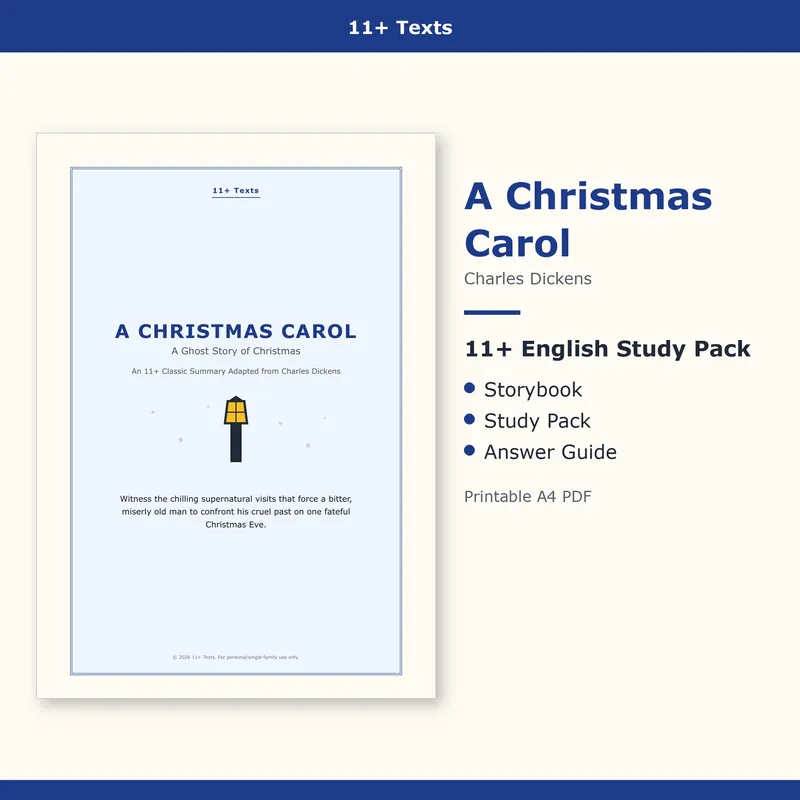
Our A Christmas Carol study pack (£3.49) has a short, readable retelling of the whole story, a 22-mark study pack and a parent answer guide, in a dyslexia-friendly layout. It is also in the All 8 Books Bundle.
Questions and answers
Is A Christmas Carol suitable for an 11+ child?
Yes, for most children in Year 5 or Year 6, especially if you read some of it together. The original uses older language, so a shorter retelling is a good way in before tackling the full book.
Will A Christmas Carol come up in the 11+ exam?
Nobody can say which passages will appear in a particular test, and you shouldn't rely on any one book. The value of reading classics is the practice they give with older vocabulary, long sentences and inference, which helps with any passage.
Where can I read the original A Christmas Carol for free?
The original text is in the public domain and is free to read on Project Gutenberg. Many libraries also have it, including abridged and illustrated editions.
Sources
The extract is quoted from the public-domain original. The questions and model answers are our own.
Practise with a classic story
More guides
- How to prepare for 11+ English comprehension at home
- 11+ inference questions: how to read between the lines
- Vocabulary in context: working out unfamiliar words in 11+ comprehension
- Similes, metaphors and personification for 11+ English
- Oliver Twist for 11+: themes, characters, vocabulary and practice questions
- Alice in Wonderland for 11+: themes, characters, vocabulary and practice questions
- Black Beauty for 11+: themes, characters, vocabulary and practice questions