Oliver Twist for 11+: themes, characters, vocabulary and practice questions
The short answer
Oliver Twist is a story about an orphan boy who survives a cruel workhouse and the criminal underworld of London, and is finally rescued by kindness. For 11+ practice, it offers rich vocabulary, long sentences and plenty to infer. Below you'll find the main themes and characters, plus a short extract from the original with 6 free questions and model answers.
What is Oliver Twist about?
Oliver Twist is a story about an orphan boy who survives a cruel workhouse and the criminal underworld of London, and is finally rescued by kindness.
Charles Dickens's novel was first published in monthly parts between 1837 and 1839. It follows Oliver, an orphan born in a workhouse, from the workhouse to the streets of London, where he falls in with Fagin's gang of young pickpockets.
Why is Oliver Twist good for 11+ English practice?
The language is rich in strong adjectives and vivid comparisons, and the characters' motives are often hinted at rather than stated, which makes it good material for inference practice. Older books like this use longer sentences and less familiar words than most modern children's fiction, which is good preparation for the kind of passages that often appear in comprehension papers.
What are the main themes?
- Poverty and the workhouse: Dickens shows how badly the poor were treated, especially children, and makes readers angry about it.
- Innocence and goodness: Oliver stays honest and gentle even when surrounded by crime, which makes him easy to root for.
- Kindness of strangers: Characters such as Mr Brownlow show that one generous person can change a life.
- Crime and justice: Fagin's gang and Bill Sikes show the danger of crime, and the ending punishes the wicked.
Who are the main characters?
| Character | Who they are |
|---|---|
| Oliver Twist | the orphan hero, born in a workhouse |
| Mr Bumble | the pompous parish beadle |
| The Artful Dodger | a quick-witted young pickpocket |
| Fagin | the leader of a gang of child thieves |
| Nancy | a member of the gang who tries to help Oliver |
| Bill Sikes | a violent burglar |
| Mr Brownlow | a kind gentleman who takes Oliver in |
Free practice: a short extract from the original
This extract is from Chapter 2 of the original book, which is in the public domain. Read it, then try the questions. The spelling and punctuation are the author's own.
The room in which the boys were fed, was a large stone hall, with a copper at one end: out of which the master, dressed in an apron for the purpose, and assisted by one or two women, ladled the gruel at mealtimes. Of this festive composition each boy had one porringer, and no more—except on occasions of great public rejoicing, when he had two ounces and a quarter of bread besides. The bowls never wanted washing. The boys polished them with their spoons till they shone again; and when they had performed this operation (which never took very long, the spoons being nearly as large as the bowls), they would sit staring at the copper, with such eager eyes, as if they could have devoured the very bricks of which it was composed; employing themselves, meanwhile, in sucking their fingers most assiduously, with the view of catching up any stray splashes of gruel that might have been cast thereon.
Which words in the extract might be tricky?
| Word | Meaning in this extract |
|---|---|
| gruel | a thin, watery porridge |
| porringer | a small bowl for porridge or soup |
| devoured | ate hungrily and completely |
| assiduously | carefully and steadily, without giving up |
| composition | here, a mixture or dish (used jokingly) |
Cover the meanings and ask your child to work each one out from the sentence first. That is the skill tested by vocabulary-in-context questions.
Free practice questions (10 marks)
These questions are written by us for this page. They are separate from the questions in our paid study pack, so you can use both. Open a model answer only after your child has had a go. For help with longer answers, see how to answer 1, 2, 3 and 4-mark questions.
Who served the gruel to the boys? (1 mark)
Show a model answer
The master of the workhouse, helped by one or two women.
Find and copy a phrase that shows how hungry the boys were. (1 mark)
Show a model answer
“as if they could have devoured the very bricks of which it was composed” (or “with such eager eyes”).
What does “assiduously” mean in the last sentence? (1 mark)
Show a model answer
Carefully and persistently, with great attention.
Dickens calls the gruel a “festive composition”. Why is this an odd choice of words, and what is he really suggesting? (2 marks)
Show a model answer
“Festive” means fit for a celebration, but gruel is thin, plain food (1). Dickens is being sarcastic, mocking how little and how poor the food is (1).
Explain why “the bowls never wanted washing”. (2 marks)
Show a model answer
The boys were so hungry that they scraped and polished every last bit of gruel out with their spoons (1), so the bowls were already clean. This shows they were not given enough to eat (1).
How does Dickens make the reader feel sorry for the boys? Use evidence from the extract. (3 marks)
Show a model answer
A strong answer makes a point, quotes and explains, for example: the boys get only “one porringer, and no more”, which shows a tiny, fixed portion (1); they “sit staring at the copper, with such eager eyes”, which suggests they are desperate for more (1); the exaggeration that they could have “devoured the very bricks” shows their hunger is extreme, so we pity them (1).
Want a full practice set for Oliver Twist?
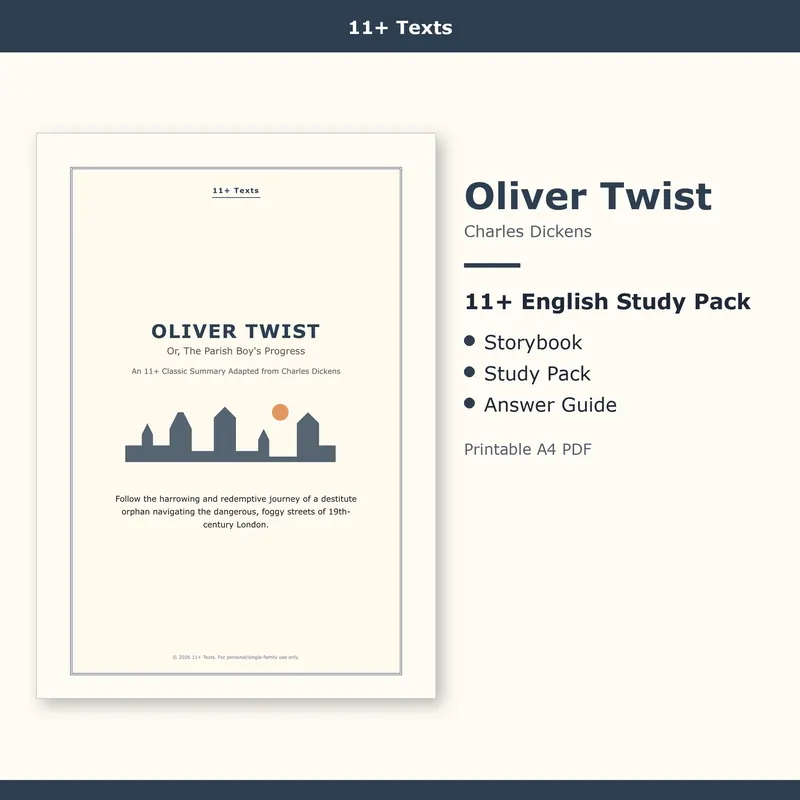
Our Oliver Twist study pack (£3.49) has a short, readable retelling of the whole story, a 22-mark study pack and a parent answer guide, in a dyslexia-friendly layout. It is also in the All 8 Books Bundle.
Questions and answers
Is Oliver Twist suitable for an 11+ child?
Yes, for most children in Year 5 or Year 6, especially if you read some of it together. The original uses older language, so a shorter retelling is a good way in before tackling the full book.
Will Oliver Twist come up in the 11+ exam?
Nobody can say which passages will appear in a particular test, and you shouldn't rely on any one book. The value of reading classics is the practice they give with older vocabulary, long sentences and inference, which helps with any passage.
Where can I read the original Oliver Twist for free?
The original text is in the public domain and is free to read on Project Gutenberg. Many libraries also have it, including abridged and illustrated editions.
Sources
The extract is quoted from the public-domain original. The questions and model answers are our own.
Practise with a classic story
More guides
- How to prepare for 11+ English comprehension at home
- 11+ inference questions: how to read between the lines
- Vocabulary in context: working out unfamiliar words in 11+ comprehension
- Similes, metaphors and personification for 11+ English
- A Christmas Carol for 11+: themes, characters, vocabulary and practice questions
- Alice in Wonderland for 11+: themes, characters, vocabulary and practice questions
- Black Beauty for 11+: themes, characters, vocabulary and practice questions