Alice in Wonderland for 11+: themes, characters, vocabulary and practice questions
The short answer
Alice's Adventures in Wonderland follows a curious girl who falls down a rabbit hole into a world of nonsense, where she changes size, meets strange creatures and stands up to the furious Queen of Hearts. For 11+ practice, it offers rich vocabulary, long sentences and plenty to infer. Below you'll find the main themes and characters, plus a short extract from the original with 5 free questions and model answers.
What is Alice's Adventures in Wonderland about?
Alice's Adventures in Wonderland follows a curious girl who falls down a rabbit hole into a world of nonsense, where she changes size, meets strange creatures and stands up to the furious Queen of Hearts.
Lewis Carroll's Alice's Adventures in Wonderland was first published in 1865. Alice follows a White Rabbit down a rabbit hole into a world of strange creatures, riddles and nonsense.
Why is Alice in Wonderland good for 11+ English practice?
Its playful, unusual vocabulary is ideal for working out word meanings from context, and the eccentric characters invite questions about what their words and actions reveal. Older books like this use longer sentences and less familiar words than most modern children's fiction, which is good preparation for the kind of passages that often appear in comprehension papers.
What are the main themes?
- Growing up and identity: Alice keeps changing size and is often asked who she is, which mirrors how confusing growing up can feel.
- Nonsense and logic: Wonderland's rules make no sense, and the fun comes from Alice trying to reason with it.
- Curiosity: Alice's curiosity starts every adventure and keeps her going.
- Questioning adults: The adults of Wonderland are rude, bossy or silly, and Alice learns to challenge them.
Who are the main characters?
| Character | Who they are |
|---|---|
| Alice | a curious, thoughtful girl |
| The White Rabbit | a nervous rabbit who is always late |
| The Cheshire Cat | a grinning cat who can disappear |
| The Mad Hatter and the March Hare | hosts of an endless tea party |
| The Caterpillar | a blunt, sleepy caterpillar who asks “Who are you?” |
| The Queen of Hearts | a furious queen who shouts “Off with their heads!” |
Free practice: a short extract from the original
This extract is from Chapter 1 of the original book, which is in the public domain. Read it, then try the questions. The spelling and punctuation are the author's own.
Alice was beginning to get very tired of sitting by her sister on the bank, and of having nothing to do: once or twice she had peeped into the book her sister was reading, but it had no pictures or conversations in it, “and what is the use of a book,” thought Alice “without pictures or conversations?” So she was considering in her own mind (as well as she could, for the hot day made her feel very sleepy and stupid), whether the pleasure of making a daisy-chain would be worth the trouble of getting up and picking the daisies, when suddenly a White Rabbit with pink eyes ran close by her.
Which words in the extract might be tricky?
| Word | Meaning in this extract |
|---|---|
| peeped | took a quick, secret look |
| considering | thinking carefully about |
| stupid | here, dull and slow because of the heat, not unintelligent |
| conversations | here, written dialogue between characters |
Cover the meanings and ask your child to work each one out from the sentence first. That is the skill tested by vocabulary-in-context questions.
Free practice questions (9 marks)
These questions are written by us for this page. They are separate from the questions in our paid study pack, so you can use both. Open a model answer only after your child has had a go. For help with longer answers, see how to answer 1, 2, 3 and 4-mark questions.
Give two reasons why Alice was bored. (2 marks)
Show a model answer
She had nothing to do (1), and her sister's book had no pictures or conversations in it (1).
What does the word “peeped” suggest about how Alice looked at the book? (1 mark)
Show a model answer
She took quick, sneaky glances rather than really reading it.
In this extract, “stupid” does not mean unintelligent. What does it mean here? (1 mark)
Show a model answer
Dull, sluggish or slow-thinking, because the heat made her sleepy.
What does the part in brackets tell us about Alice at this moment? (2 marks)
Show a model answer
She is finding it hard to think clearly (1) because the hot day has made her drowsy (1). (It may also hint that what follows is a dream.)
The long sentence describes ordinary, slow things, then ends with “suddenly a White Rabbit with pink eyes ran close by her”. Why is this effective? (3 marks)
Show a model answer
The sentence builds a lazy, sleepy mood (1); the word “suddenly” breaks that mood and surprises the reader (1); the unusual detail of the pink-eyed rabbit signals that the adventure is about to begin, making us want to read on (1).
Want a full practice set for Alice in Wonderland?
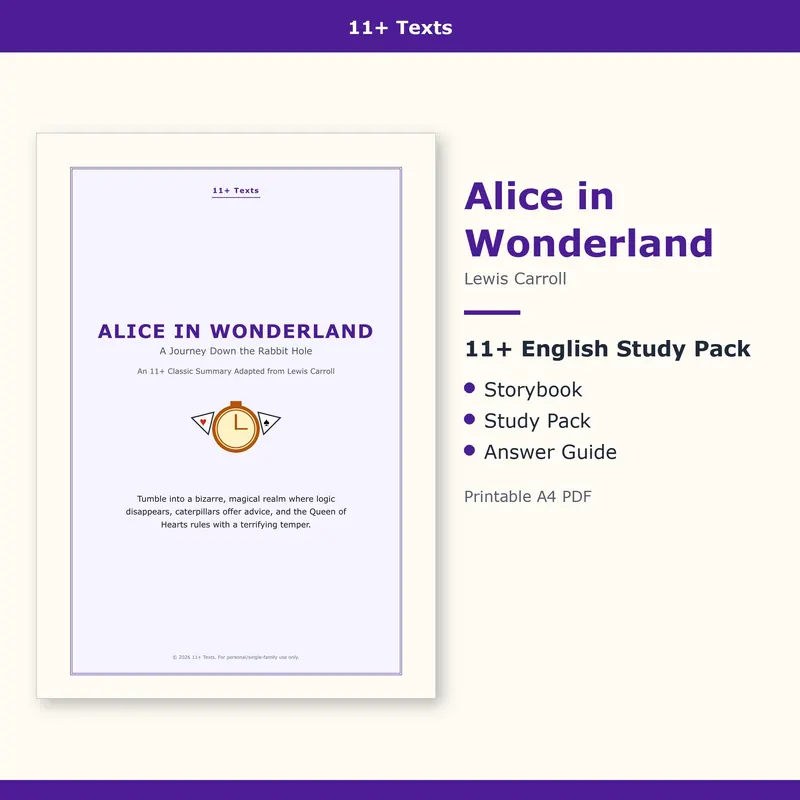
Our Alice in Wonderland study pack (£3.49) has a short, readable retelling of the whole story, a 22-mark study pack and a parent answer guide, in a dyslexia-friendly layout. It is also in the All 8 Books Bundle.
Questions and answers
Is Alice's Adventures in Wonderland suitable for an 11+ child?
Yes, for most children in Year 5 or Year 6, especially if you read some of it together. The original uses older language, so a shorter retelling is a good way in before tackling the full book.
Will Alice's Adventures in Wonderland come up in the 11+ exam?
Nobody can say which passages will appear in a particular test, and you shouldn't rely on any one book. The value of reading classics is the practice they give with older vocabulary, long sentences and inference, which helps with any passage.
Where can I read the original Alice's Adventures in Wonderland for free?
The original text is in the public domain and is free to read on Project Gutenberg. Many libraries also have it, including abridged and illustrated editions.
Sources
The extract is quoted from the public-domain original. The questions and model answers are our own.
Practise with a classic story
More guides
- How to prepare for 11+ English comprehension at home
- 11+ inference questions: how to read between the lines
- Vocabulary in context: working out unfamiliar words in 11+ comprehension
- Similes, metaphors and personification for 11+ English
- Oliver Twist for 11+: themes, characters, vocabulary and practice questions
- A Christmas Carol for 11+: themes, characters, vocabulary and practice questions
- Black Beauty for 11+: themes, characters, vocabulary and practice questions