Black Beauty for 11+: themes, characters, vocabulary and practice questions
The short answer
Black Beauty is told by a horse, who describes his life from a happy foal to a London cab horse and back to a kind home, showing how much horses suffer or thrive depending on how people treat them. For 11+ practice, it offers rich vocabulary, long sentences and plenty to infer. Below you'll find the main themes and characters, plus a short extract from the original with 5 free questions and model answers.
What is Black Beauty about?
Black Beauty is told by a horse, who describes his life from a happy foal to a London cab horse and back to a kind home, showing how much horses suffer or thrive depending on how people treat them.
Anna Sewell's only novel was first published in 1877. It is narrated by the horse himself, Black Beauty, who describes the kind and cruel owners he works for over his life.
Why is Black Beauty good for 11+ English practice?
Because the story is told from the horse's point of view, it is useful for practising questions about narrative viewpoint, feelings and the contrast between kindness and cruelty. Older books like this use longer sentences and less familiar words than most modern children's fiction, which is good preparation for the kind of passages that often appear in comprehension papers.
What are the main themes?
- Kindness and cruelty to animals: Anna Sewell wanted readers to treat horses better, and the book shows both gentle and cruel owners.
- Responsibility: Owners and grooms are judged by whether they take care of the animals in their charge.
- Friendship: Beauty's friendships with Ginger and Merrylegs comfort him through hard times.
- Having no voice: Because the narrator is a horse, readers see how animals cannot speak up for themselves.
Who are the main characters?
| Character | Who they are |
|---|---|
| Black Beauty | the narrator, a handsome black horse |
| Duchess | Beauty's mother, who gives him wise advice |
| Ginger | a mare who has been badly treated and can be bad-tempered |
| Merrylegs | a cheerful pony |
| Squire Gordon | Beauty's kind early owner |
| John Manly | Squire Gordon's coachman |
| Jerry Barker | a kind London cab driver |
Free practice: a short extract from the original
This extract is from Chapter 1 of the original book, which is in the public domain. Read it, then try the questions. The spelling and punctuation are the author's own.
The first place that I can well remember was a large pleasant meadow with a pond of clear water in it. Some shady trees leaned over it, and rushes and water-lilies grew at the deep end. Over the hedge on one side we looked into a plowed field, and on the other we looked over a gate at our master's house, which stood by the roadside; at the top of the meadow was a grove of fir trees, and at the bottom a running brook overhung by a steep bank.
Which words in the extract might be tricky?
| Word | Meaning in this extract |
|---|---|
| rushes | tall grass-like plants that grow by water |
| grove | a small group of trees |
| brook | a small stream |
| overhung | hung over or stuck out above |
| plowed | an older spelling of ploughed |
Cover the meanings and ask your child to work each one out from the sentence first. That is the skill tested by vocabulary-in-context questions.
Free practice questions (8 marks)
These questions are written by us for this page. They are separate from the questions in our paid study pack, so you can use both. Open a model answer only after your child has had a go. For help with longer answers, see how to answer 1, 2, 3 and 4-mark questions.
The narrator is Black Beauty. Which word in the first sentence shows the story is told in the first person? (1 mark)
Show a model answer
“I”.
Find and copy two adjectives used to describe the meadow or the pond. (1 mark)
Show a model answer
Any two of: “large”, “pleasant”, “clear”.
“Plowed” is an older spelling. How would we spell it in modern British English? (1 mark)
Show a model answer
Ploughed.
“Some shady trees leaned over it.” Name the technique and explain its effect. (2 marks)
Show a model answer
Personification, because trees cannot really lean like a person (1). It makes the trees seem gentle and protective, as if they are watching over the pond (1).
What impression does the writer give of Black Beauty's first home? Use evidence. (3 marks)
Show a model answer
It seems peaceful and safe (1), for example “a large pleasant meadow” (1); the details of “clear water”, “water-lilies” and “a running brook” make it sound natural, fresh and beautiful, a happy place to grow up (1).
Want a full practice set for Black Beauty?
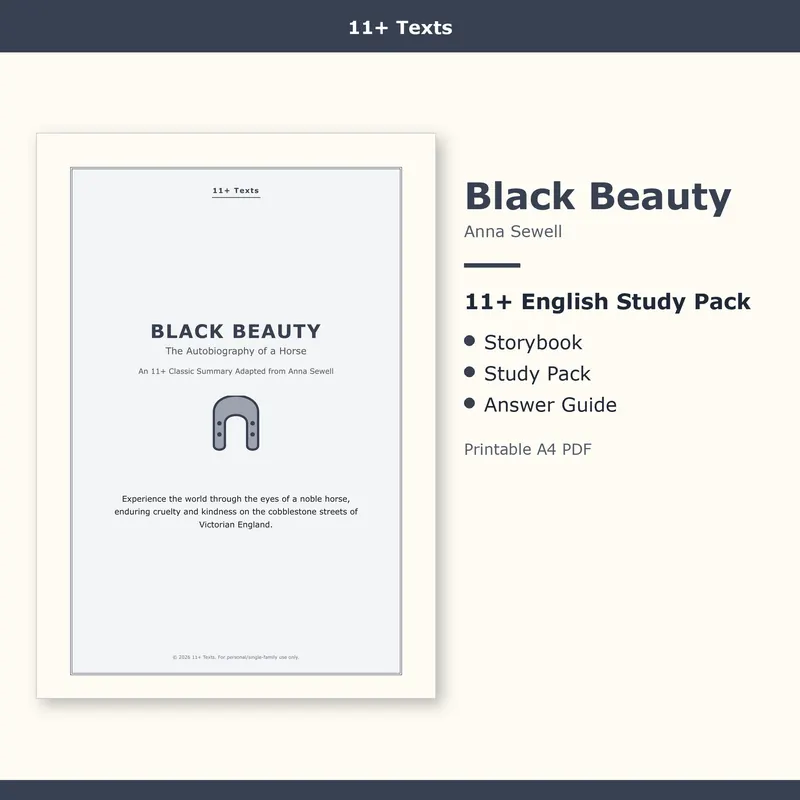
Our Black Beauty study pack (£3.49) has a short, readable retelling of the whole story, a 22-mark study pack and a parent answer guide, in a dyslexia-friendly layout. It is also in the All 8 Books Bundle.
Questions and answers
Is Black Beauty suitable for an 11+ child?
Yes, for most children in Year 5 or Year 6, especially if you read some of it together. The original uses older language, so a shorter retelling is a good way in before tackling the full book.
Will Black Beauty come up in the 11+ exam?
Nobody can say which passages will appear in a particular test, and you shouldn't rely on any one book. The value of reading classics is the practice they give with older vocabulary, long sentences and inference, which helps with any passage.
Where can I read the original Black Beauty for free?
The original text is in the public domain and is free to read on Project Gutenberg. Many libraries also have it, including abridged and illustrated editions.
Sources
The extract is quoted from the public-domain original. The questions and model answers are our own.
Practise with a classic story
More guides
- How to prepare for 11+ English comprehension at home
- 11+ inference questions: how to read between the lines
- Vocabulary in context: working out unfamiliar words in 11+ comprehension
- Similes, metaphors and personification for 11+ English
- Oliver Twist for 11+: themes, characters, vocabulary and practice questions
- A Christmas Carol for 11+: themes, characters, vocabulary and practice questions
- Alice in Wonderland for 11+: themes, characters, vocabulary and practice questions