Peter Pan for 11+: themes, characters, vocabulary and practice questions
The short answer
Peter Pan (the novel was first called Peter and Wendy) is about a boy who refuses to grow up and takes Wendy, John and Michael Darling to Neverland, where they meet the Lost Boys, fairies, mermaids and Captain Hook. For 11+ practice, it offers rich vocabulary, long sentences and plenty to infer. Below you'll find the main themes and characters, plus a short extract from the original with 5 free questions and model answers.
What is Peter Pan about?
Peter Pan (the novel was first called Peter and Wendy) is about a boy who refuses to grow up and takes Wendy, John and Michael Darling to Neverland, where they meet the Lost Boys, fairies, mermaids and Captain Hook.
J. M. Barrie's Peter Pan first appeared as a stage play in 1904, and the novel, Peter and Wendy, followed in 1911. Peter, the boy who never grows up, takes Wendy and her brothers to Neverland, where they meet fairies, the Lost Boys and Captain Hook.
Why is Peter Pan good for 11+ English practice?
It has clear heroes and villains, lively descriptive language and plenty of action, which makes it an approachable text for younger or less confident readers. Older books like this use longer sentences and less familiar words than most modern children's fiction, which is good preparation for the kind of passages that often appear in comprehension papers.
What are the main themes?
- Growing up: The book is both fun and sad about the fact that every child except Peter has to grow up.
- Home and mothers: Wendy acts as a mother to the Lost Boys, and the Darling children eventually long for home.
- Imagination: Neverland is a world built from children's games and stories.
- Adventure and danger: Pirates, fights and the ticking crocodile make Neverland thrilling but risky.
Who are the main characters?
| Character | Who they are |
|---|---|
| Peter Pan | a boy who never grows up |
| Wendy Darling | the eldest Darling child, who mothers the Lost Boys |
| John and Michael | Wendy's younger brothers |
| Tinker Bell | a jealous, loyal fairy |
| Captain Hook | the pirate captain, Peter's enemy |
| Mr and Mrs Darling | the children's parents |
| Nana | the dog who acts as the children's nurse |
Free practice: a short extract from the original
This extract is from Chapter 1 of the original book, which is in the public domain. Read it, then try the questions. The spelling and punctuation are the author's own.
All children, except one, grow up. They soon know that they will grow up, and the way Wendy knew was this. One day when she was two years old she was playing in a garden, and she plucked another flower and ran with it to her mother. I suppose she must have looked rather delightful, for Mrs. Darling put her hand to her heart and cried, “Oh, why can’t you remain like this for ever!” This was all that passed between them on the subject, but henceforth Wendy knew that she must grow up. You always know after you are two. Two is the beginning of the end.
Which words in the extract might be tricky?
| Word | Meaning in this extract |
|---|---|
| plucked | picked |
| henceforth | from then on |
| romantic | here, dreamy and full of imagination |
| mocking | teasing or gently making fun |
Cover the meanings and ask your child to work each one out from the sentence first. That is the skill tested by vocabulary-in-context questions.
Free practice questions (9 marks)
These questions are written by us for this page. They are separate from the questions in our paid study pack, so you can use both. Open a model answer only after your child has had a go. For help with longer answers, see how to answer 1, 2, 3 and 4-mark questions.
How old was Wendy when she found out she would grow up? (1 mark)
Show a model answer
Two years old.
What does “henceforth” mean? (1 mark)
Show a model answer
From that time on.
Why is “All children, except one, grow up.” an effective first sentence? (2 marks)
Show a model answer
It is short and sounds like a simple fact, so it grabs attention (1), and the words “except one” create mystery, making the reader want to find out who the one child is (1).
What does Mrs Darling's reaction suggest about how she feels? (2 marks)
Show a model answer
She loves Wendy very much, shown by putting her “hand to her heart” (1), and she is sad that Wendy will not stay little for ever (1).
The narrator says “I suppose” and “Two is the beginning of the end.” What do these show about the narrator's voice? (3 marks)
Show a model answer
The narrator talks directly to the reader, like a storyteller (1); “I suppose” shows they are guessing, which feels chatty and friendly (1); “the beginning of the end” is a dramatic, slightly sad joke, mixing humour with sadness about growing up (1).
Want a full practice set for Peter Pan?
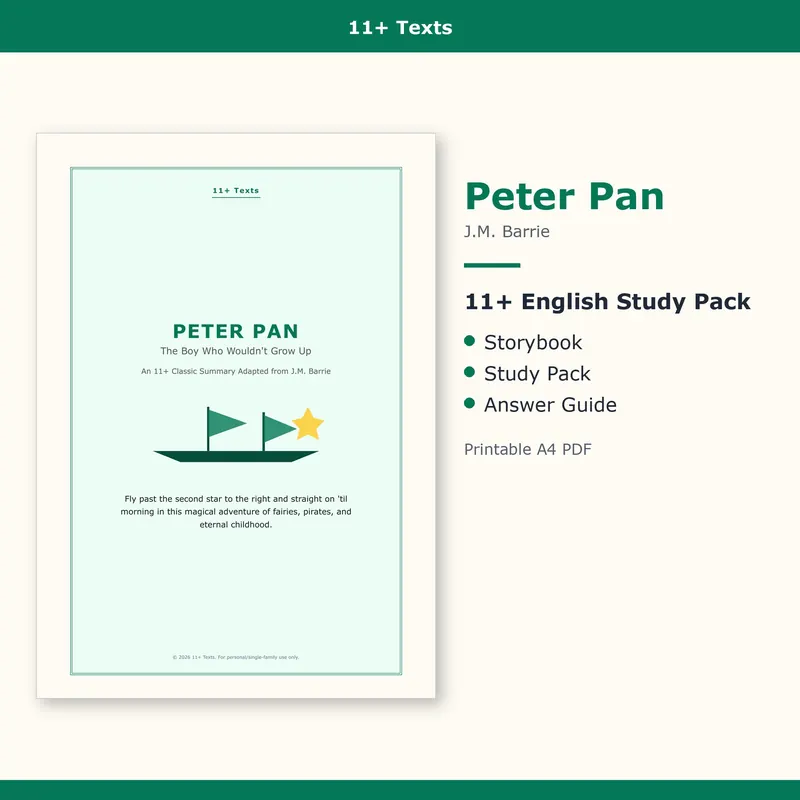
Our Peter Pan study pack (£3.49) has a short, readable retelling of the whole story, a 22-mark study pack and a parent answer guide, in a dyslexia-friendly layout. It is also in the All 8 Books Bundle.
Questions and answers
Is Peter Pan suitable for an 11+ child?
Yes, for most children in Year 5 or Year 6, especially if you read some of it together. The original uses older language, so a shorter retelling is a good way in before tackling the full book.
Will Peter Pan come up in the 11+ exam?
Nobody can say which passages will appear in a particular test, and you shouldn't rely on any one book. The value of reading classics is the practice they give with older vocabulary, long sentences and inference, which helps with any passage.
Where can I read the original Peter Pan for free?
The original text is in the public domain and is free to read on Project Gutenberg. Many libraries also have it, including abridged and illustrated editions.
Sources
The extract is quoted from the public-domain original. The questions and model answers are our own.
Practise with a classic story
More guides
- How to prepare for 11+ English comprehension at home
- 11+ inference questions: how to read between the lines
- Vocabulary in context: working out unfamiliar words in 11+ comprehension
- Similes, metaphors and personification for 11+ English
- Oliver Twist for 11+: themes, characters, vocabulary and practice questions
- A Christmas Carol for 11+: themes, characters, vocabulary and practice questions
- Alice in Wonderland for 11+: themes, characters, vocabulary and practice questions