The Railway Children for 11+: themes, characters, vocabulary and practice questions
The short answer
The Railway Children is about Roberta (Bobbie), Peter and Phyllis, who move to a cottage by a railway after their father is suddenly taken away, and who make friends, prevent an accident and finally help clear his name. For 11+ practice, it offers rich vocabulary, long sentences and plenty to infer. Below you'll find the main themes and characters, plus a short extract from the original with 6 free questions and model answers.
What is The Railway Children about?
The Railway Children is about Roberta (Bobbie), Peter and Phyllis, who move to a cottage by a railway after their father is suddenly taken away, and who make friends, prevent an accident and finally help clear his name.
E. Nesbit's The Railway Children was first published as a book in 1906. When their father is taken away, Roberta, Peter and Phyllis move with their mother to a cottage near a railway line in the countryside.
Why is The Railway Children good for 11+ English practice?
Much of the story depends on what the children notice and what the adults leave unsaid, so it is good for practising inference about feelings and motives. Older books like this use longer sentences and less familiar words than most modern children's fiction, which is good preparation for the kind of passages that often appear in comprehension papers.
What are the main themes?
- Family and loyalty: The children and Mother stick together and protect one another through a hard time.
- Coping with change: The family goes from comfort to being poor and must adapt.
- Kindness and community: Neighbours, Perks the porter and the Old Gentleman show how kindness spreads.
- Justice: The mystery of Father's absence turns out to be an injustice that has to be put right.
Who are the main characters?
| Character | Who they are |
|---|---|
| Roberta (Bobbie) | the eldest, thoughtful and caring |
| Peter | the middle child, who wants to be an engineer |
| Phyllis | the youngest, well-meaning but clumsy |
| Mother | who writes stories to earn money |
| Father | who is taken away at the start |
| Perks | the friendly station porter |
| The Old Gentleman | a passenger who becomes a friend |
Free practice: a short extract from the original
This extract is from Chapter 1 of the original book, which is in the public domain. Read it, then try the questions. The spelling and punctuation are the author's own.
They were not railway children to begin with. I don't suppose they had ever thought about railways except as a means of getting to Maskelyne and Cook's, the Pantomime, Zoological Gardens, and Madame Tussaud's. They were just ordinary suburban children, and they lived with their Father and Mother in an ordinary red-brick-fronted villa, with coloured glass in the front door, a tiled passage that was called a hall, a bath-room with hot and cold water, electric bells, French windows, and a good deal of white paint, and 'every modern convenience', as the house-agents say. There were three of them. Roberta was the eldest. Of course, Mothers never have favourites, but if their Mother HAD had a favourite, it might have been Roberta. Next came Peter, who wished to be an Engineer when he grew up; and the youngest was Phyllis, who meant extremely well.
Which words in the extract might be tricky?
| Word | Meaning in this extract |
|---|---|
| suburban | living in the suburbs, the outer parts of a town or city |
| villa | here, a comfortable house in the suburbs |
| convenience | something that makes life easier |
| favourite | the one liked best |
Cover the meanings and ask your child to work each one out from the sentence first. That is the skill tested by vocabulary-in-context questions.
Free practice questions (11 marks)
These questions are written by us for this page. They are separate from the questions in our paid study pack, so you can use both. Open a model answer only after your child has had a go. For help with longer answers, see how to answer 1, 2, 3 and 4-mark questions.
What did Peter want to be when he grew up? (1 mark)
Show a model answer
An engineer.
What does “suburban” mean? (1 mark)
Show a model answer
Living in the suburbs, the outer area of a town or city.
What does the first sentence make the reader expect? (2 marks)
Show a model answer
“To begin with” suggests their life is going to change (1), so we expect that they will become “railway children” later in the story (1).
Why does the writer put ‘every modern convenience’ in quotation marks? (2 marks)
Show a model answer
She is quoting what house-agents say in adverts (1), which gently pokes fun at the phrase and at how ordinary the house really is (1).
“Phyllis, who meant extremely well.” What can you infer about Phyllis? (2 marks)
Show a model answer
She tries hard to be good and helpful (1), but the phrase hints that things often go wrong for her despite her good intentions (1).
How does the narrator make the opening feel friendly and humorous? (3 marks)
Show a model answer
The narrator speaks directly to us with “I don't suppose” (1); the joke that Mothers “never have favourites” but if she had, “it might have been Roberta” is playful, with “HAD” in capitals for emphasis (1); calling things “ordinary” twice is gently teasing and makes us curious about how their life will become extraordinary (1).
Want a full practice set for The Railway Children?
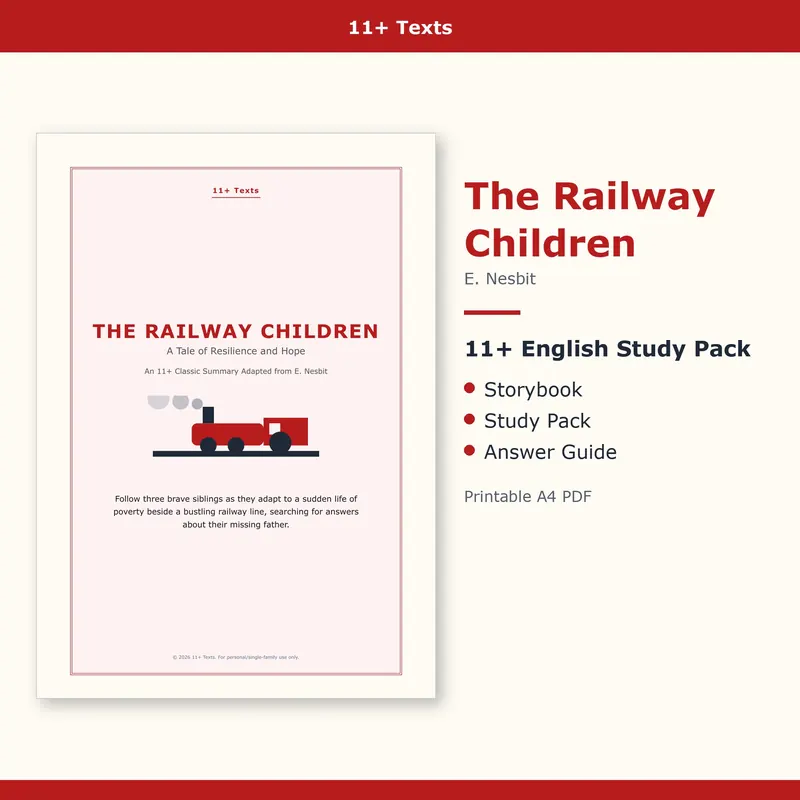
Our The Railway Children study pack (£3.49) has a short, readable retelling of the whole story, a 22-mark study pack and a parent answer guide, in a dyslexia-friendly layout. It is also in the All 8 Books Bundle.
Questions and answers
Is The Railway Children suitable for an 11+ child?
Yes, for most children in Year 5 or Year 6, especially if you read some of it together. The original uses older language, so a shorter retelling is a good way in before tackling the full book.
Will The Railway Children come up in the 11+ exam?
Nobody can say which passages will appear in a particular test, and you shouldn't rely on any one book. The value of reading classics is the practice they give with older vocabulary, long sentences and inference, which helps with any passage.
Where can I read the original The Railway Children for free?
The original text is in the public domain and is free to read on Project Gutenberg. Many libraries also have it, including abridged and illustrated editions.
Sources
The extract is quoted from the public-domain original. The questions and model answers are our own.
Practise with a classic story
More guides
- How to prepare for 11+ English comprehension at home
- 11+ inference questions: how to read between the lines
- Vocabulary in context: working out unfamiliar words in 11+ comprehension
- Similes, metaphors and personification for 11+ English
- Oliver Twist for 11+: themes, characters, vocabulary and practice questions
- A Christmas Carol for 11+: themes, characters, vocabulary and practice questions
- Alice in Wonderland for 11+: themes, characters, vocabulary and practice questions