The Secret Garden for 11+: themes, characters, vocabulary and practice questions
The short answer
The Secret Garden is about Mary Lennox, a lonely, spoilt girl sent from India to her uncle's house in Yorkshire, where she finds a locked garden, makes friends with Dickon and her cousin Colin, and brings the garden and herself back to life. For 11+ practice, it offers rich vocabulary, long sentences and plenty to infer. Below you'll find the main themes and characters, plus a short extract from the original with 5 free questions and model answers.
What is The Secret Garden about?
The Secret Garden is about Mary Lennox, a lonely, spoilt girl sent from India to her uncle's house in Yorkshire, where she finds a locked garden, makes friends with Dickon and her cousin Colin, and brings the garden and herself back to life.
Frances Hodgson Burnett's novel was first published in 1911. Mary Lennox, a spoilt and lonely girl, is sent to live in her uncle's house on the Yorkshire moors, where she discovers a locked, neglected garden.
Why is The Secret Garden good for 11+ English practice?
The setting changes with the seasons and mirrors how the characters change, which gives good material for questions on description, mood and character development. Older books like this use longer sentences and less familiar words than most modern children's fiction, which is good preparation for the kind of passages that often appear in comprehension papers.
What are the main themes?
- Healing and growth: As the garden comes back to life, so do Mary and Colin.
- Nature: Fresh air, plants and animals are shown as powerful and good for people.
- Friendship: Mary learns to care about others through Dickon, Martha and Colin.
- Neglect and love: Mary and Colin have both been neglected, and the story shows what changes when they are cared for.
Who are the main characters?
| Character | Who they are |
|---|---|
| Mary Lennox | a sour, lonely girl who changes |
| Archibald Craven | Mary's grieving uncle |
| Mrs Medlock | the strict housekeeper |
| Martha Sowerby | a cheerful housemaid |
| Dickon | Martha's brother, who is wonderful with animals |
| Colin Craven | Mary's cousin, who believes he is an invalid |
| Ben Weatherstaff | the grumpy gardener |
Free practice: a short extract from the original
This extract is from Chapter 1 of the original book, which is in the public domain. Read it, then try the questions. The spelling and punctuation are the author's own.
When Mary Lennox was sent to Misselthwaite Manor to live with her uncle everybody said she was the most disagreeable-looking child ever seen. It was true, too. She had a little thin face and a little thin body, thin light hair and a sour expression. Her hair was yellow, and her face was yellow because she had been born in India and had always been ill in one way or another. Her father had held a position under the English Government and had always been busy and ill himself, and her mother had been a great beauty who cared only to go to parties and amuse herself with gay people.
Which words in the extract might be tricky?
| Word | Meaning in this extract |
|---|---|
| disagreeable | unpleasant or unfriendly |
| expression | the look on someone's face |
| position | here, a job or post |
| gay | here, its older meaning: cheerful and fond of fun |
Cover the meanings and ask your child to work each one out from the sentence first. That is the skill tested by vocabulary-in-context questions.
Free practice questions (9 marks)
These questions are written by us for this page. They are separate from the questions in our paid study pack, so you can use both. Open a model answer only after your child has had a go. For help with longer answers, see how to answer 1, 2, 3 and 4-mark questions.
Why was Mary's face yellow? (1 mark)
Show a model answer
Because she had been born in India and had always been ill.
What does “disagreeable” mean? (1 mark)
Show a model answer
Unpleasant or unfriendly.
What is the effect of the short sentence “It was true, too.”? (2 marks)
Show a model answer
It is blunt and surprising, because the narrator agrees with the unkind comment instead of defending Mary (1). This makes the reader curious about her and shows the narrator will be honest (1).
The word “thin” is used three times in one sentence. Why? (2 marks)
Show a model answer
Repetition emphasises how small and frail she is (1), suggesting she is unhealthy and perhaps uncared for (1).
What can you infer about how Mary's parents treated her? Use evidence. (3 marks)
Show a model answer
Her father was “always busy”, suggesting he had no time for her (1); her mother “cared only to go to parties”, so she put her own fun first (1); the word “only” implies Mary was ignored, which may explain her sour expression (1).
Want a full practice set for The Secret Garden?
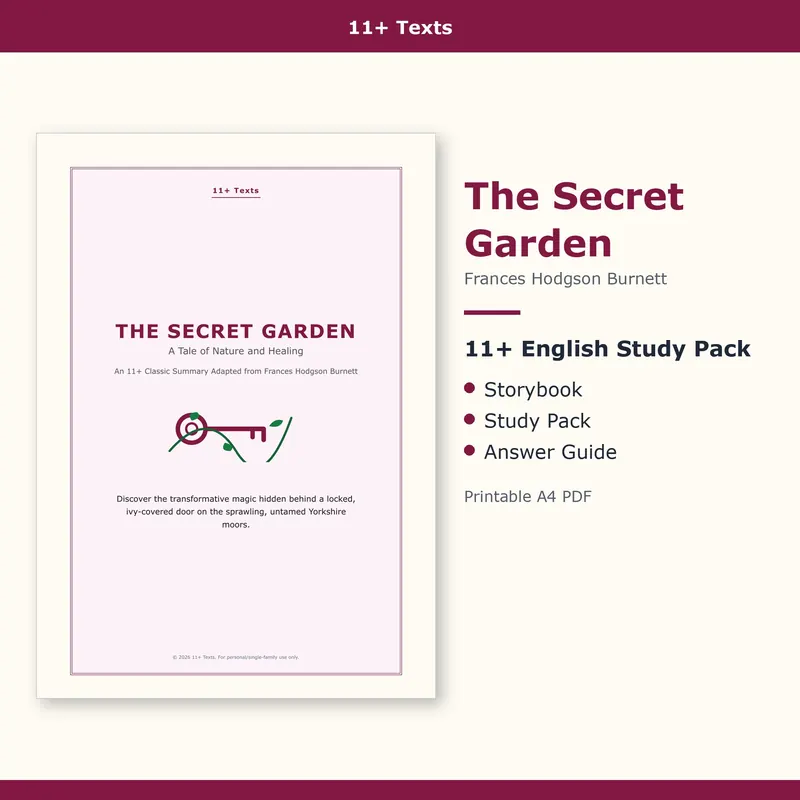
Our The Secret Garden study pack (£3.49) has a short, readable retelling of the whole story, a 22-mark study pack and a parent answer guide, in a dyslexia-friendly layout. It is also in the All 8 Books Bundle.
Questions and answers
Is The Secret Garden suitable for an 11+ child?
Yes, for most children in Year 5 or Year 6, especially if you read some of it together. The original uses older language, so a shorter retelling is a good way in before tackling the full book.
Will The Secret Garden come up in the 11+ exam?
Nobody can say which passages will appear in a particular test, and you shouldn't rely on any one book. The value of reading classics is the practice they give with older vocabulary, long sentences and inference, which helps with any passage.
Where can I read the original The Secret Garden for free?
The original text is in the public domain and is free to read on Project Gutenberg. Many libraries also have it, including abridged and illustrated editions.
Sources
The extract is quoted from the public-domain original. The questions and model answers are our own.
Practise with a classic story
More guides
- How to prepare for 11+ English comprehension at home
- 11+ inference questions: how to read between the lines
- Vocabulary in context: working out unfamiliar words in 11+ comprehension
- Similes, metaphors and personification for 11+ English
- Oliver Twist for 11+: themes, characters, vocabulary and practice questions
- A Christmas Carol for 11+: themes, characters, vocabulary and practice questions
- Alice in Wonderland for 11+: themes, characters, vocabulary and practice questions