The Wind in the Willows for 11+: themes, characters, vocabulary and practice questions
The short answer
The Wind in the Willows follows Mole, Ratty, Badger and the boastful Mr Toad through life on the riverbank, Toad's reckless adventures with motor cars, and the friends' battle to win back Toad Hall from the weasels. For 11+ practice, it offers rich vocabulary, long sentences and plenty to infer. Below you'll find the main themes and characters, plus a short extract from the original with 5 free questions and model answers.
What is The Wind in the Willows about?
The Wind in the Willows follows Mole, Ratty, Badger and the boastful Mr Toad through life on the riverbank, Toad's reckless adventures with motor cars, and the friends' battle to win back Toad Hall from the weasels.
Kenneth Grahame's novel was first published in 1908. Mole, Ratty, Badger and the boastful Mr Toad share adventures on the riverbank and in the Wild Wood.
Why is The Wind in the Willows good for 11+ English practice?
The animal characters behave like people, which makes it a natural text for spotting personification, and Toad's boasting gives plenty to infer about character. Older books like this use longer sentences and less familiar words than most modern children's fiction, which is good preparation for the kind of passages that often appear in comprehension papers.
What are the main themes?
- Friendship: The animals look after one another, especially when Toad gets into trouble.
- Home: Mole's longing for his own little home, and the fight for Toad Hall, show how much home matters.
- Adventure versus comfort: The characters are tempted by excitement but value safety and routine.
- Learning from mistakes: Toad's boasting and crazes lead to disaster before he finally changes.
Who are the main characters?
| Character | Who they are |
|---|---|
| Mole | a shy, curious animal new to the river |
| Ratty (the Water Rat) | a kind, river-loving friend |
| Mr Toad | rich, boastful and obsessed with motor cars |
| Badger | wise, gruff and respected |
| Otter | a friendly river animal |
| The weasels and stoats | who take over Toad Hall |
Free practice: a short extract from the original
This extract is from Chapter 1 of the original book, which is in the public domain. Read it, then try the questions. The spelling and punctuation are the author's own.
The Mole had been working very hard all the morning, spring-cleaning his little home. First with brooms, then with dusters; then on ladders and steps and chairs, with a brush and a pail of whitewash; till he had dust in his throat and eyes, and splashes of whitewash all over his black fur, and an aching back and weary arms. Spring was moving in the air above and in the earth below and around him, penetrating even his dark and lowly little house with its spirit of divine discontent and longing. It was small wonder, then, that he suddenly flung down his brush on the floor, said “Bother!” and “O blow!” and also “Hang spring-cleaning!” and bolted out of the house without even waiting to put on his coat.
Which words in the extract might be tricky?
| Word | Meaning in this extract |
|---|---|
| whitewash | a white paint for walls |
| lowly | humble, small and plain |
| discontent | a feeling of not being satisfied |
| penetrating | getting right inside |
| bolted | ran off suddenly |
Cover the meanings and ask your child to work each one out from the sentence first. That is the skill tested by vocabulary-in-context questions.
Free practice questions (9 marks)
These questions are written by us for this page. They are separate from the questions in our paid study pack, so you can use both. Open a model answer only after your child has had a go. For help with longer answers, see how to answer 1, 2, 3 and 4-mark questions.
Give two things the Mole used for spring-cleaning. (1 mark)
Show a model answer
Any two of: brooms, dusters, ladders, steps, chairs, a brush, a pail of whitewash.
What does “bolted” mean here? (1 mark)
Show a model answer
Ran off suddenly and quickly.
How does the second sentence show how hard the Mole had worked? (2 marks)
Show a model answer
It is a long list (“First… then… then…”) that piles up all the jobs he did (1), and it ends with the results: dust, whitewash on his fur, “an aching back and weary arms” (1).
“Spring was moving in the air.” Name the technique and explain its effect. (2 marks)
Show a model answer
Personification, because spring is described as if it is alive and moving (1). It makes spring seem like a force calling the Mole outside, which explains his sudden change of mood (1).
How does the writer show the Mole's change of mood? Use evidence. (3 marks)
Show a model answer
At first he is tired and working steadily, with “weary arms” (1); then he “suddenly flung down his brush”, a violent verb showing he has had enough (1); his exclamations “Bother!” and “Hang spring-cleaning!” and leaving “without even waiting to put on his coat” show excitement and impatience to get outside (1).
Want a full practice set for The Wind in the Willows?
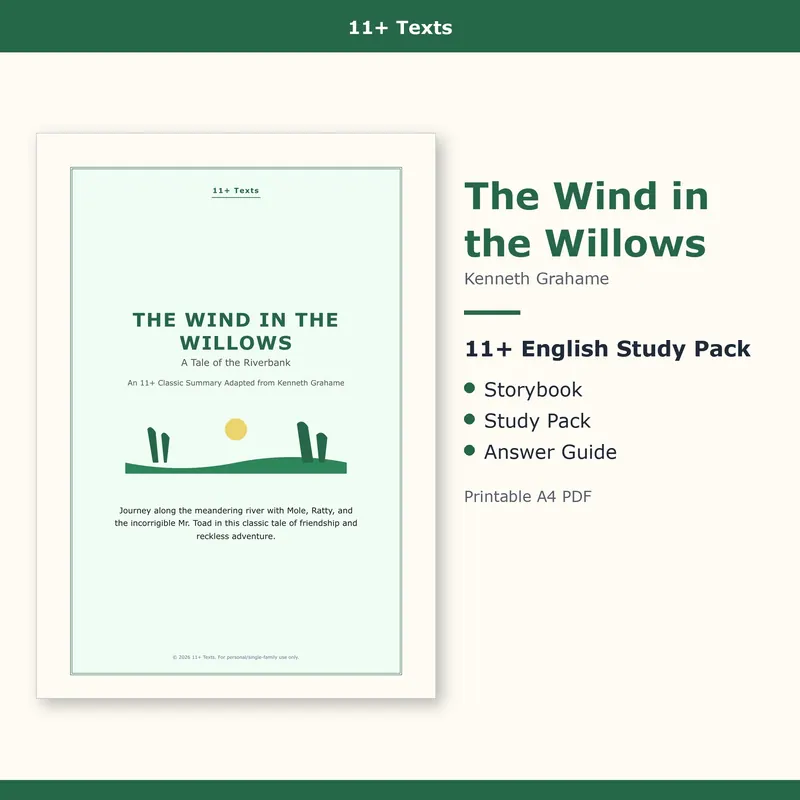
Our The Wind in the Willows study pack (£3.49) has a short, readable retelling of the whole story, a 22-mark study pack and a parent answer guide, in a dyslexia-friendly layout. It is also in the All 8 Books Bundle.
Questions and answers
Is The Wind in the Willows suitable for an 11+ child?
Yes, for most children in Year 5 or Year 6, especially if you read some of it together. The original uses older language, so a shorter retelling is a good way in before tackling the full book.
Will The Wind in the Willows come up in the 11+ exam?
Nobody can say which passages will appear in a particular test, and you shouldn't rely on any one book. The value of reading classics is the practice they give with older vocabulary, long sentences and inference, which helps with any passage.
Where can I read the original The Wind in the Willows for free?
The original text is in the public domain and is free to read on Project Gutenberg. Many libraries also have it, including abridged and illustrated editions.
Sources
The extract is quoted from the public-domain original. The questions and model answers are our own.
Practise with a classic story
More guides
- How to prepare for 11+ English comprehension at home
- 11+ inference questions: how to read between the lines
- Vocabulary in context: working out unfamiliar words in 11+ comprehension
- Similes, metaphors and personification for 11+ English
- Oliver Twist for 11+: themes, characters, vocabulary and practice questions
- A Christmas Carol for 11+: themes, characters, vocabulary and practice questions
- Alice in Wonderland for 11+: themes, characters, vocabulary and practice questions